Last weekend I spent two days at the Entrepreneurship Summit in Berlin. I’ve been going for many years now.
Not every edition is equally inspiring. This year wasn’t one of the strongest for me. It always depends on the speakers and the topics they bring.
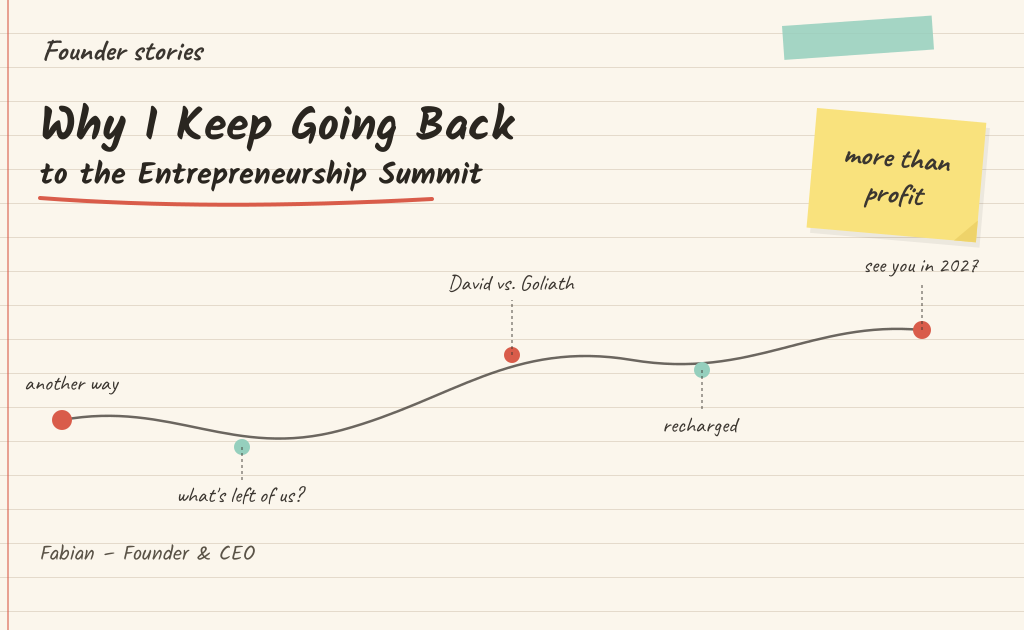
But I’ll be back next year. Here’s why.
A counterweight to the startup script
Most of the founder world follows the same script. Grow exponentially. Raise money and burn it fast. Reach the exit. Get rich.
Growth is the goal, and money is the proof.
I never followed that script. I built Mailbutler without outside investors, and I never wanted to sell it. In the typical startup world, that choice usually needs explaining.
At the summit, it doesn’t. The focus is on social entrepreneurship, intrinsic motivation and sustainability. It’s about companies that grow with their people, not at their expense.
Most people there share the values that drive me and my business.
There is more to being a business owner than maximizing profits.
The founder sets the tone
The summit was founded by Prof. Günter Faltin. He started the Teekampagne and wrote Kopf schlägt Kapital. Its core idea: a well-thought-out concept matters more than capital.
What strikes me every year is how authentically he stands for this. It isn’t a slogan on a stage banner. You can feel that spirit in every session and every talk.
Values only work when the person at the top actually lives them. I learned the same lesson when we defined Mailbutler’s core values. The event, the company, the team: the spirit always starts with the founder.
The talks that aren’t about business
Some of my favorite talks are only loosely related to founding or running a company.
Prof. Gerald Hüther is a neuroscientist. For years, his big theme has been Potenzialentfaltung: the unfolding of human potential. This year, he took it into the age of AI.
His question was simple and uncomfortable. We already handed physical labor to machines. Now we’re handing over cognitive labor to AI. If AI does the thinking, what’s left for us? Are we deskilling ourselves?
He didn’t offer an answer. That was the point. He wants people to think about it critically and find their own balance.
If machines do the work and AI does the thinking, what’s left of us as humans?
As someone who builds AI into a product, this one stuck with me. Our AI assistant Maia writes, summarizes and answers emails. That saves people time. But it also raises Hüther’s question: where does helpful end and deskilling begin?
David versus Goliath
Christian Kroll founded Ecosia, the search engine that plants trees with its profits. He has spent years challenging Google and Microsoft in search. Now he’s taking them on in AI answers too.
He built Ecosia into a successful company without the usual venture capital. Then he went one step further. He turned Ecosia into a steward-owned company. Since then, no one can ever sell it or take its profits out. Not even him.
That’s the part that stays with me. I never wanted to sell Mailbutler. Steward ownership is a way to make that permanent instead of just a promise. For Mailbutler, it’s an idea I find very appealing.
You don’t need investors to take on the biggest players. You need a clear mission and the patience to grow on your own terms.
Questioning the rules
A thread ran through many talks this year: questioning the business world and its rules.
Can’t we have a good life without destroying the planet? Without exploiting people?
These questions can sound naive. They aren’t. Many people in that room are already building businesses that answer them. Not in theory, but in practice, every day.
Recharged
Choosing a different path as a business owner takes energy. You constantly make decisions that the dominant playbook would call wrong. Not taking the investment. Not optimizing for the exit. Putting people before growth targets.
The summit gives me that energy back. Not every talk is brilliant. But the room reminds me that many people share the same vision of how business can be done differently.
That’s what keeps me going back. It’s not about the program. It’s about the people.
I didn’t leave this year with a concrete to-do list. I left with something more important: renewed motivation to keep doing it my way, and to make a living from it.
I’ve already booked my tickets for 2027.