Project Phoenix worked. I'm sure of that. Every week or so, we ticked another item off the list. The team could see progress. So could I.
But when I sat down to evaluate it at the end of 2025, I also saw something less comfortable. Most of what we had changed was qualitative. How we worked. How we talked to each other. How clear the product was. The numbers had moved in the right direction. They just hadn't moved far enough.
That's where Project Rise comes in.
What Phoenix actually gave us
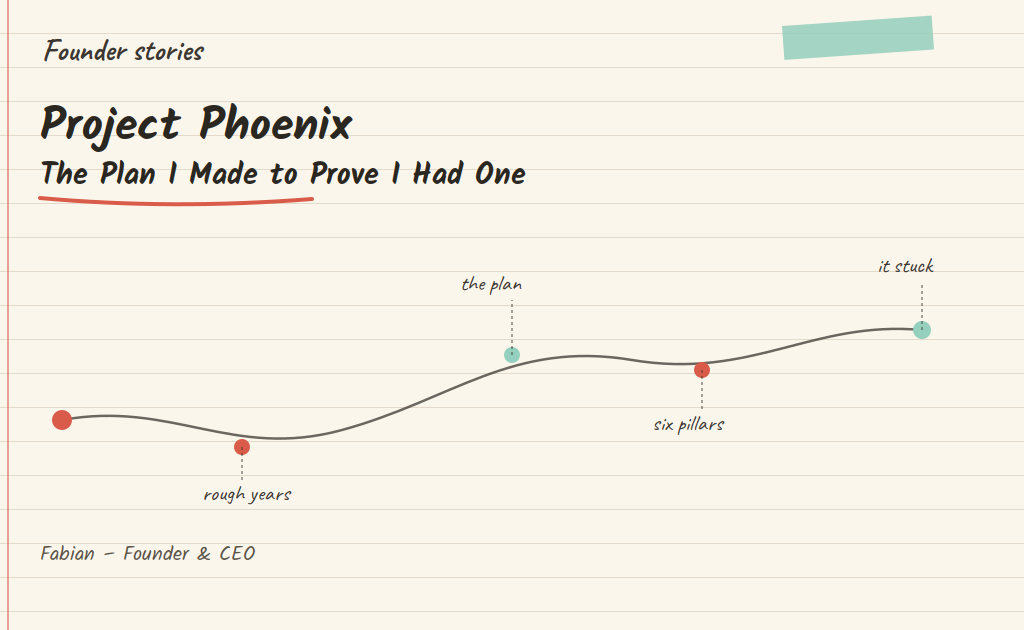
I called Phoenix the plan I made to prove I had one. Looking back, its biggest value wasn't the plan itself. It was what the plan gave the team: hope, and a direction everyone could see.
After my co-founder stepped back, people wanted to know where this was going. They didn't just accept the plan. They seemed to have been waiting for one. Most of it still came from me. But more and more colleagues started pushing things forward on their own, because they wanted us to reach the goals too.
That mattered to me more than any single checkmark. In a team our size, ownership is everything. Not just for developers. For everyone. I want people who think full-stack, who see the whole picture and not just their slice of it.
It's also why I've stopped thinking of Holacracy as something we failed to introduce. In a company of under ten people, there isn't much hierarchy left to dissolve. I think we already live most of what Holacracy tries to create for much bigger organizations.
Phoenix made us feel like a company with a future. Rise had to prove it.
A very different kickoff
We kicked off Project Rise in January 2026. It felt nothing like the Phoenix presentation.
Phoenix was my vision. Rise was business. We organized the company into three areas: Product & Development, Growth, and Customer Success. Each team defined up to three KPIs, a benchmark, and targets for three, six, nine and twelve months. Every month, in our WhazzUp meeting, each team reported where they stood.
Honestly? I don't think the team was fully ready for it. Most of them had never looked closely at KPIs. For some, the numbers felt far away from their daily work. And I didn't sugarcoat where we were. Our primary metrics didn't look good. We were profitable, but only just. Over the year, that margin got thinner, not thicker.
I can imagine that felt intimidating. Maybe even worrying. But I'd rather have a team that knows the real situation than one that's surprised by it later.
The midterm check-in
In July, we did the honest check-in we had planned from the start.
Product & Development was the clear bright spot. The backlog was down to fewer than 20 items and fewer than five known bugs. That's small enough to fix new bugs within a single sprint. Much of that came from AI agents. More on that below.
Customer Success had good satisfaction scores, above 80 percent. But we resolved fewer than 40 percent of conversations with the first reply. We set ourselves a goal of more than 75.
Growth was the hard one. Our conclusion was blunt: we have a top-of-funnel problem. Registrations kept falling, even though we were spending a lot on marketing. We didn't hit our targets for created accounts.
We didn't pivot. We decided to keep investing in the growth activities that showed results, experiment even more, and measure every step of the funnel so we know exactly where people drop off.
Letting go, one team at a time
One team actually started back during Phoenix, but only really came into its own during Rise: our dedicated Growth Team.
It works largely on its own. It has a defined budget. I meet with them once a month.
If you've read my Phoenix post, you know I'm bad at stepping back from operations. I still am. Getting my hands dirty is what I enjoy most. But the Growth Team is the first place where I've genuinely handed over the wheel. It's a small step. It's a real one.
The change nobody planned for
The biggest shift of 2026 isn't on any Rise slide. It's AI.
We now use AI agents across the entire company, and it has changed how almost everyone works. Development got so fast that reviews became the bottleneck, not writing code. Our first-level support now runs on an AI agent, and our human team focuses on making it better. Even the Growth Team ships website changes themselves, without waiting for a developer.
For me personally, it's been a treadmill. Every problem I fixed with Claude revealed two new ones. My backlog grew longer while I closed more tasks than ever before. Claude keeps me busy, as I like to say. Only now, in November, does it slowly feel like we're getting on top of it again.
This deserves its own post, and it'll get one.
What Phoenix taught me about Rise
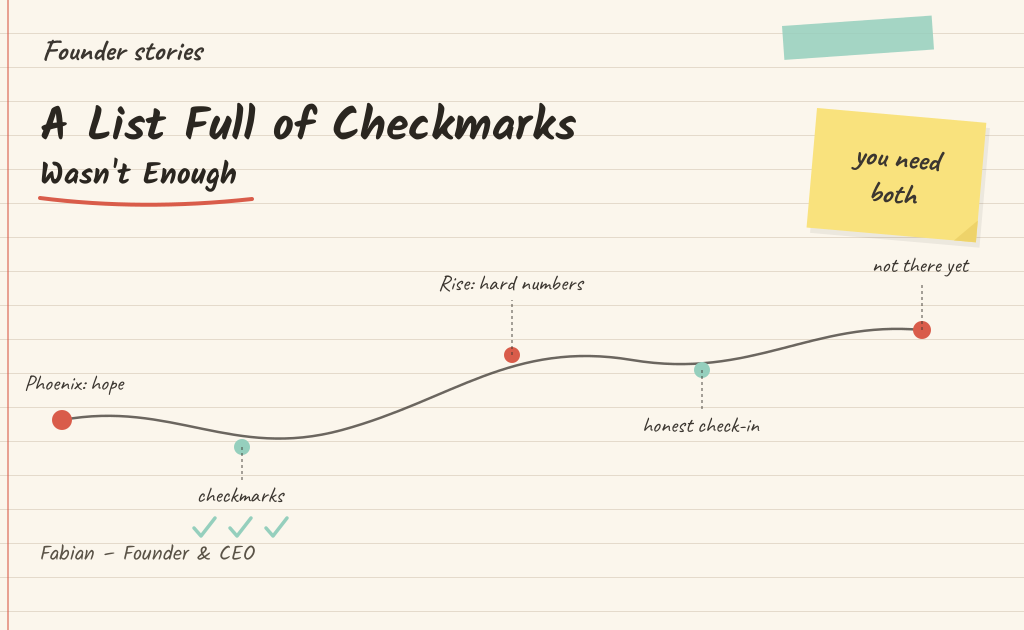
A plan that makes people feel good and a plan that moves the numbers are not the same plan. You need both.
Phoenix gave us the foundation: clarity, stability, a team that believed in where we were going. Rise had to turn that into hard results. Revenue. Leads. Registrations. Churn. Customer satisfaction.
I'm not going to pretend Rise has succeeded yet. It hasn't. The product is the strongest it has ever been. The team works faster than ever. But the numbers still aren't where they need to be.
Rise ends with a final evaluation in December. I'll share how it went, including what we decide to do next.