A couple of weeks ago, I wrote this on LinkedIn:
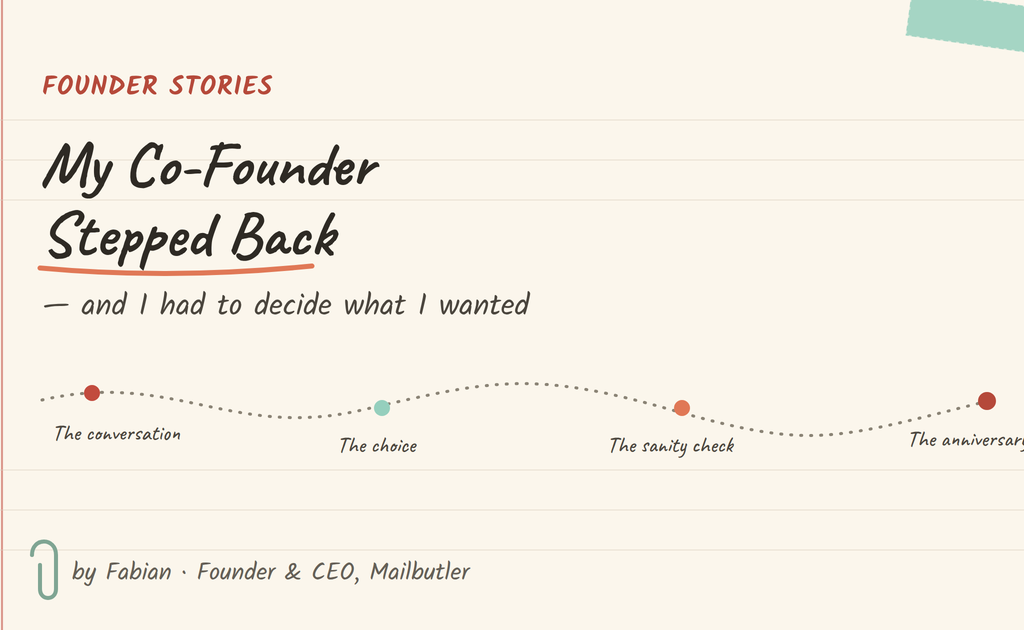
Last year, at our 10-year anniversary, I stood up in front of my whole team to say a few words. I couldn't get a single sentence out. I just cried. It didn't feel wrong. It felt like the truest thing I'd done in years.
That post was the short version. A LinkedIn post has a length limit; this story doesn't really fit one. So here's the fuller version — what actually led up to that moment, and what came after it.
How it started
A year before that anniversary, my co-founder told me he was ready to move on. It didn't blindside me — I'd felt it coming for a while. He'd spent a decade building his part of this company, and he wanted something new that he could own start to finish, without waiting on anyone else. I understood it completely. If you've built something with someone for ten years, you know that wanting to build your own next thing, alone, isn't a rejection of what came before. It's just a different itch.
And then I had to decide what I wanted.
The choice
The honest, simplest option on the table was to jointly wind the company down. No fights over what happens next, no handover, no risk. Minimize expenses, close it out cleanly, move on. We talked about it seriously — I want to say that plainly, because it would be dishonest to write this as if there was only ever one obvious answer.
I didn't take that option, and it wasn't because winding down felt like failure. It was because I wasn't done. I was still enjoying what I did, how I got to do it, and who I got to do it with, and my list of ideas for this product and this company was — is — long. Going from co-leading the company to running all of it myself could have felt like a loss. Instead, it felt like finally being able to bring my whole self to it — developer, product person, and now the person steering the whole ship.
Making sure it wasn't just emotion
Wanting to keep going isn't a good enough reason by itself — plenty of founders keep going out of momentum or sunk cost long after they should stop. So before I let myself get attached to the decision, I checked whether it actually made sense, not just whether I wanted it to.
Financially, the cost measures we'd put in place earlier that year had worked. We were profitable again, and the trend lines on churn, new active users, conversions, and customer satisfaction were all pointing the right way. On the product side, New Horizons — our Apple Mail rebuild — had landed well. Most of our Apple Mail customers were already on it, it kept getting better with every release, and we had no shortage of ideas for where to take it next.
None of that made the decision easy, but it made it sane. Taking over a company you're excited about is one thing; taking over one that's quietly sinking is a very different bet, and I wasn't going to romanticize my way past that distinction.
What actually changed
Day to day, less than you'd think. All teams now report to me on paper, but the goal was the opposite of centralizing more — I wanted the teams more autonomous, not less. I started one-on-one feedback sessions with everyone, just to talk about roles, how people were feeling, what they wanted next.
The bigger shift was more subtle. My co-founder used to be the person who'd push back on my ideas in the room — the second opinion I could argue with before anything became a decision. I don't have that built in anymore, so our cross-team meeting has become the place that does that job instead: the forum where the team challenges and pressure-tests ideas with me, because I need that friction from somewhere now. Full transparency about where we stand and where we're headed matters more to me now than it ever did — precisely because I don't have a co-founder in the room to keep me honest by default anymore. The team has to be able to do that, and for that they need to actually see what's going on.
The anniversary
Which brings me back to where this post started. A year into running things this way, we hit Mailbutler's 10-year anniversary, and I stood up to say a few words to the whole team.
I'd planned something. I don't remember most of it, because I didn't get through it — I got a sentence or two in and just started crying in front of everyone. It wasn't planned and it wasn't graceful, but it was true: a decade of building this thing, a year of learning to carry it differently, and a room full of people who'd chosen to stay and build it with me. That's not something I can talk about in a measured, CEO-appropriate tone, apparently. I've made my peace with that.
The next day, I wrote something for the team. One line from it has stuck with me since:
We embrace change and adapt to thrive, we rise from the ashes like a phoenix.
A few weeks later, that line became the name of a company-wide initiative — Project Phoenix — to rebuild how we set goals and hold ourselves accountable as a smaller, leaner leadership team. I'll write about Project Phoenix properly in its own post, because it deserves more than a paragraph here. For now: it started less because I had all the answers, and more because I wanted the team to know this was a new era, and I was fully in it.
The actual point
I still don't have all the answers. Growth, marketing, sales — none of that comes naturally to me, and I'm learning it in public, one Whazzup meeting at a time. That's a strange thing to admit as the person now responsible for all of it, but it's the truth, and this series has never been about pretending otherwise.
What I'd tell any founder facing the same fork in the road is the same thing I told myself back then: figure out what actually drives you. For me, it was never the money — it's building something, owning the decisions, showing up for a crew I'd follow anywhere. That's the same test I wrote about in the very first post in this series, and it's the one that got me through this one too.
I'd genuinely like to hear from other founders who've been through a co-founder exit, on either side of it — what made you stay, or what made you go? Drop a comment, I read and reply to all of them.