On Thursday, I’m leaving for almost four weeks. Costa Rica, until mid-December.
Before I go, I’ll do what I do every year. I’ll delete Teams from my phone. Then Outlook. Then Stripe, Google Analytics, Google Ads, and every other app that could pull me back into work with a single notification.
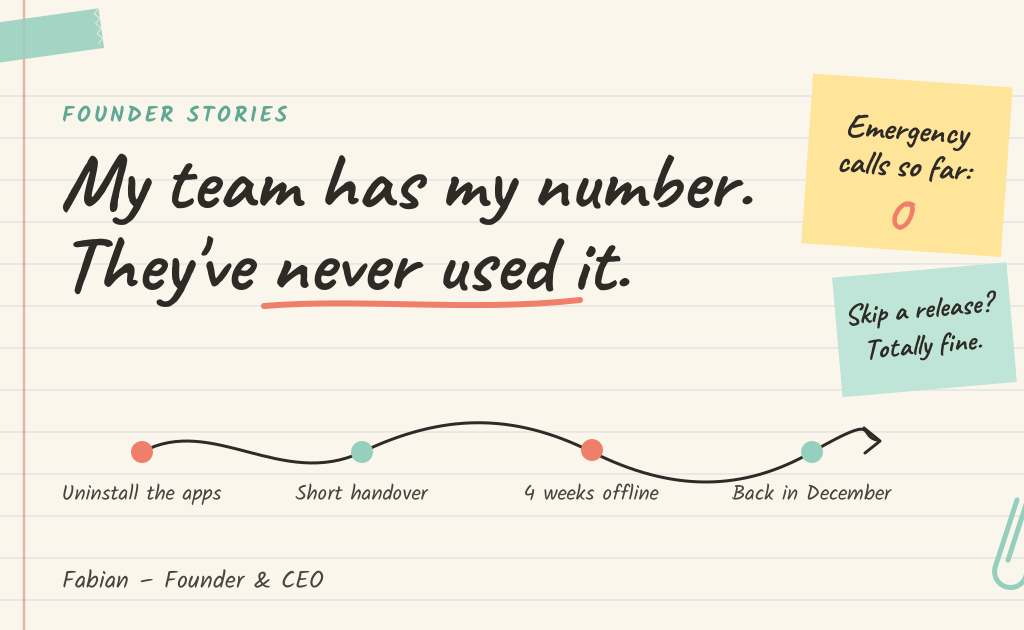
My team has my phone number for emergencies. In all the years since I founded Mailbutler, nobody has ever needed it.
Why November
My girlfriend and I are both busy people. We’re also bad at planning vacations during the year. It just slips.
And honestly, we don’t want to leave Berlin in summer. It’s a wonderful place to be from June to September. There’s no good reason to go anywhere else.
November is different. The days get short, wet and dark. That’s when we fly far away to collect some vitamin D and do something completely different.
Different is the key word. My regular workday is spent in front of a screen. So our trips are the opposite: hiking, diving, swimming, snorkeling. This year we’ll spend two weeks exploring Costa Rica on foot with a guided group. Then a little more than a week on the Pacific coast, with a few days of diving.
I’ve taken long vacations like this every year since founding the company. Not once in a while. Every year.
Digital detox means no connection
For me, a vacation only works if I’m really gone. Ideally, no phone and no internet at all. At the very least, nothing that connects me to work.
That’s why I uninstall the apps instead of muting them. A muted app is still one tap away. And a quick look at the revenue dashboard is never just a quick look. It turns into a question. The question turns into a message. And suddenly I’m working from a beach.
A quick look at the dashboard is never just a quick look.
The surprising part: this is easy for me by now. I’m mostly excited about the new experiences ahead. It helps that I’m strict with myself during the rest of the year too. My devices are basically always in “do not disturb” mode. That probably deserves its own post.
What happens while I’m gone
Things go wrong while I’m away. Of course they do. We run a SaaS product for three different email platforms.
Over the years, the backend had issues. The database got slower than it should be. Small and medium incidents, the kind every software company knows. The team handled every single one without me.
My favorite example: a big tender showed up right before one of my vacations. A real opportunity, with real deadlines. The founder reflex says: postpone the trip, or at least stay reachable. I didn’t. I left it to the team to prepare our application.
We didn’t win. We made the top three. And I’m fine with that. The team learned a lot from the process, and we’ve improved because of it. I doubt we would have learned more if I’d stayed and done it myself.
Vacation is important to me. Not even a tender changes that.
The handover is short
My preparation is surprisingly small. A short handover document or a Teams message. It’s always some version of the same few points.
You own the process. You have each other, and each other’s expertise. You don’t need to take any risks. If you’re not comfortable deploying a release while I’m gone, skip it. Missing one or two release cycles is completely fine. And here’s my number, for real emergencies.
That’s it.
The most important line in that message is the permission not to ship. A small team that feels it must keep the release schedule at any cost will take risks it shouldn’t. A team that knows “wait until Fabian is back” is a valid option can decide calmly. Sometimes they deploy. Sometimes they don’t. Both are fine, and the decision is theirs.
Giving your team permission not to ship is what makes it safe for them to ship.
Trust is the real system
None of this works because of a document. It works because I trust my team fully. They know how to help each other. They can handle almost any situation on their own. And they know I mean it when I say I won’t be checking.
I’ll be honest: this is also about my own mental wellbeing. Being the only managing director of a company is a weight you carry everywhere. Four weeks without it is how I come back with energy, perspective and new ideas. A founder vacation isn’t a break from running the company. For me, it’s part of running it.
If my company needs me every single day, I haven’t built a company. I’ve built a job.
Coming back
People often ask whether coming back is stressful. A full inbox, weeks of decisions to catch up on.
For me, it’s one of the best parts. I’m genuinely excited to find out what changed while I was gone. What did the team decide? What did they ship, or choose not to ship? What did they solve in a way I wouldn’t have?
What I haven’t figured out yet
There’s one thing I want to fix. My approach to vacation isn’t written down anywhere for the team. It’s just how I do it.
I’ve always assumed switching off is easier for my team than for me. They don’t carry the same weight a founder does. But I’m not sure that’s true. When the person at the top is visibly online, it’s hard to feel truly off. So I want to put it in writing: when you’re on vacation, you’re gone. No checking in. No “just one quick message.”
See you in December
This is my last post for a few weeks. If you comment on it, I won’t see it until mid-December. That’s not rude. That’s the point.
If you’re a founder who hasn’t taken a real vacation in years, maybe this is your sign. Start with less than four weeks if you need to. But uninstall the apps.
Your team has your number. Let them show you they don’t need it.